Weird Anxiety: A Comprehensive OCD Clinical Training Cohort
with Amanda Steed, LCSW-S, LICSW
You think it might be OCD. You just don't know where to start.
Weird Anxiety is a year-long, small-group cohort for clinicians who want to learn what OCD is, and then how to treat it with confidence without exposures.
Cohort of up to 18 · Live on Zoom · January to December 2027 · Registration closes January 15
Does this sound like you?
You're hearing more about OCD. Or you're sitting with a client and thinking it might be OCD, but you're not entirely sure. You usually work with trauma, maybe with EMDR or IFS, and these are the clients with "weird anxiety" that doesn't respond the way you expect.
When you go looking for training, there are so many options that it's overwhelming.
What most trainings skip
Most OCD trainings jump straight into how to treat it. But if you can't screen and assess well, you won't know who needs OCD treatment, and you won't know when it's OCD, something else, or both. That's where we start.
I built this because it's the training I wished I had: a place to learn OCD from start to finish, in community, at a pace fast enough that you can start using it with clients, and slow enough that you don't get overwhelmed.
Why a year
I learn best by being taught something, seeing it done, and then trying it myself, with someone to give me feedback along the way. Most trainings happen in big chunks - two to four days in a row. After three years of running consultation groups, I've seen that people learn better in relationship with others.
A small group that meets regularly means we're not only learning about OCD together. We get to know each other and help each other along the way. Over a year you get nuanced feedback on real cases, and you can look back and say, "I didn't know how to do this six months ago, and now I'm doing it confidently." It's a slower pace, and I believe a slower pace allows for deeper integration.
What you'll learn
Assessment, screening and differential diagnosis. You'll be able to tell where it's OCD, where it's something else, and where it's OCD and something else.
Psychoeducation. I'll teach it, and then help you figure out how you want to teach your clients.
Inference-based CBT (I-CBT). The 12 ICBT modules plus a bonus with psychoeducation, in the order I've found works best:
Module 0: Basic psychoeducation, an introduction to the Obsessional Sequence (the foundation of I-CBT), and the tricks and cheats of OCD. I teach these first because they help clients see how their OCD is showing up.
Module 1: The Bubble. Together with the Obsessional Sequence, this is foundational. The rest of the training builds on it.
Modules 2 to 5: Inferential Confusion, Logic and Reasoning, Obsessional vs. Reasonable Doubt, Possibility Is Irrelevant. These show the machinery behind how obsessional doubt is built, and how to tell doubts based on the senses from doubts based on obsessional reasoning.
Module 6: The OCD Narrative. The OCD story, and how OCD gets the client to buy in to the obsessional doubt.
Module 7: Feared Possible Self. The underlying fear about the self that drives the other doubts - also known as the vulnerable self theme.
Module 8: Real Self. Who the client really is - who they know themselves to be, and who their loved ones know them to be.
Module 9: Alternative Narrative. AKA the REAL story - what's actually happening in the here and now.
Module 10: Effortless Use of the Senses. Trusting your senses, even when your OCD is triggered.
Module 11: Reality Sensing. Putting it together so clients can notice when OCD is present and stay in the here and now.
Module 12: Remission and Recovery. What it means to be in remission and recovery and what challenges may arise.
Working with parts and with EMDR. My approach to IFS for OCD integrates I-CBT and helps clients work with their parts to identify the felt sense of the bubble, so they can tell when their OCD is triggered and leave the bubble. For EMDR, we'll go through each phase and look at how OCD might show up and how to respond, including what to do if OCD gets triggered during reprocessing.
Relapse prevention and trauma work with OCD. Learn how to support clients in their remission and recovery process.
What you'll be able to do
Accurately identify, assess, and diagnose OCD in clients
Help clients get relief from their OCD symptoms
Feel more confident and competent, which builds trust with your clients
Be discerning about who needs OCD treatment before you start trauma work
Explain what's happening in the brain, and why treatment works
Who this is for
Clinicians who love to learn in community with one another.
Anyone who is ready to jump in to working with OCD clients, but needs tools to do so.
Clinicians who work with trauma, best for those with some IFS or EMDR training - reach out if you’re not sure. Sessions 1 to 3 on assessment and I-CBT are useful on their own, and the later sessions build on EMDR and IFS.
Open to students through seasoned clinicians. (participants practice within their own scope and code of ethics)
Who this is not for
Anyone looking to learn exposure treatment. My approach doesn't require or include exposures. This isn't because I don't see the value in exposure treatment, it's just not my approach.
Anyone looking for a quick weekend training - this training is designed to be done in community over the course of a year.
Anyone who wants to listen to lectures with their camera off and leave. Community is a big part of how I teach and consult, and I want to work with people who want to build it with me.

Meet Amanda
I've worked intensively with OCD for about three and a half years, using inference-based CBT for most of that time. I'm honestly a nerd, and OCD was my ADHD hyperfocus for a solid year. I dove in and learned as much as I could. I'm still in consultation groups for OCD and I still read books about it, because I'm a lifelong learner. I don't know everything, but I trust myself to find it, learn it and share it with people who need it. I love to dive into the details in a way that isn't complex, and I hope you'll find it welcoming and not intimidating.
The Details
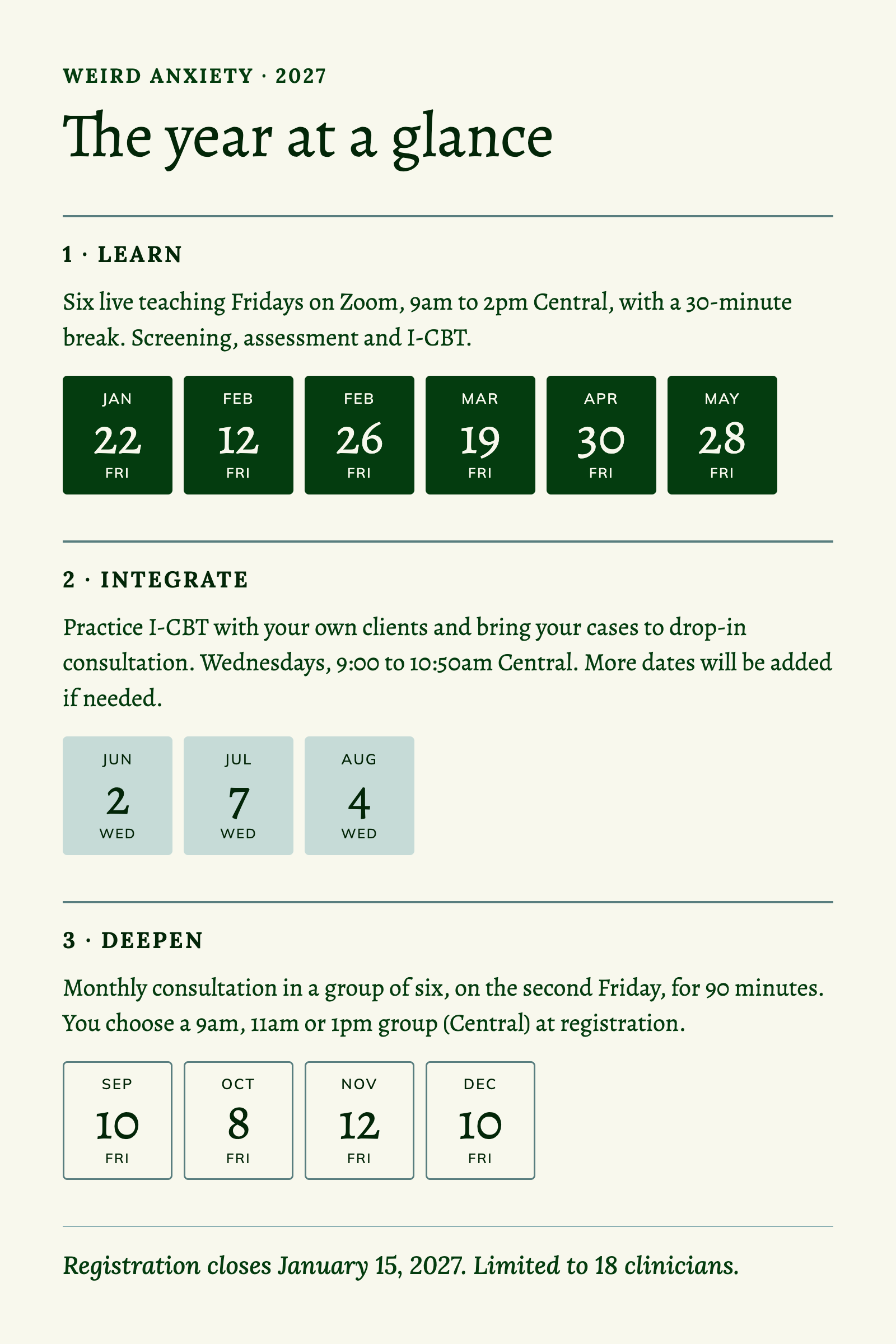
Live teaching (Zoom, 9am to 2pm Central, with a 30-minute break): Jan 22, Feb 12, Feb 26, Mar 19, Apr 30, May 28
Summer drop-in consultation (Included in the price but optional) (Wednesdays, 9:00 to 10:50am): Jun 2, Jul 7, Aug 4. More dates will be added if needed.
Fall consultation groups (2nd Fridays, 90 minutes): Sep 10, Oct 8, Nov 12, Dec 10. You choose a 9am, 11am or 1pm group at registration.
Time commitment: About 45 hours over the year, including 27 teaching hours and approximately 6 to 8 hours of reading. Between Jan 22 and Feb 12 you'll read through the I-CBT script you'll use with clients. You don't need to memorize it, just be familiar with the language, and we'll practice together.
What's included: Live teaching, summer and fall consultation, I-CBT modules and scripts (shared after our first session), teaching recordings through May 2028, and a certificate of attendance. Registered participants can get a discounted rate on one-on-one consultation with me at $150 per 50 minutes instead of $175.
Investment: $1,530 if you register and pay in full, or $150 a month for 12 months, charged monthly beginning when you register. Registration closes January 15, 2027. Only 18 seats.
Good to Know
CE. This training is not approved by a national accrediting body. Many licensing boards accept training taught by a licensed clinician toward continuing education requirements, but rules vary by state and license type. Please check with your board before registering. You'll receive a certificate of attendance with my credentials after the teaching portion.
Attendance. The I-CBT days are especially important. If you miss a session, you'll need to watch the recording and take a quiz to make it up - failure to do so will result in not receiving your certificate of attendance.
Camera. Please keep your camera on. It helps us build community. We are all human - if you need to eat, stretch or step away I totally understand, but I would love to be looking at your faces while I'm teaching!
Recording. I record my teaching only, for future use. Participants aren't on the recordings. Q&A, role-play and consultation groups aren't recorded. Case confidentiality applies in all group time.
Refunds. Seats in this cohort are limited so that I can get to know everyone in the group. For that reason, refunds are handled as follows:
Until registration closes. You can cancel for a refund (minus processing fees) at any time until 11:59pm Central on January 15, 2027. If you are on the monthly plan, I will cancel it and refund any payments already collected minus processing fees.
After registration closes. There are no refunds. The I-CBT modules and scripts are shared after our first session on January 22, and your seat cannot be filled once the cohort begins.
Monthly plan. If you are on the monthly plan and withdraw after January 15, the remaining payments are still owed, for a total of $1,800.
Emergencies. If a catastrophic emergency beyond your control prevents you from taking part, contact me and I will consider it case by case. These exceptions are my decision.
If I cancel. If I have to cancel the cohort, you will receive a full refund.
Clarity Backed by Expertise
-
No - my approach doesn't require or include exposures. In consultation I can help you think through how you might approach them, but the teaches will not cover exposures.
-
No - the EMDR portion covers resourcing and client-preparation techniques for Phase 2, and then goes through each phase of EMDR to show how OCD might show up and how to respond. I will not cover specific EMDR approaches to OCD.
-
Yes, through May 2028. I'll give you access through Zoom.
-
You definitely do not need EMDR or IFS training to get the most out of the training. It's best if you have some in one or both approaches, but it isn’t required. The IFS portion is easier to follow without training, but the EMDR portion will be much less useful without it - that said, you can always use that time to grab a snack or do some doodling.
-
No, I have PA'd for Melissa's training and have been in consultation with her for three years (and counting.) She is a mentor to me and has taught me so much about OCD. That said, my approach to IFS for OCD is focused on integrating inference-based CBT and helping clients work with their parts to identify the felt sense of the bubble, so they can tell when their OCD is triggered and leave it. IFS supports I-CBT in my approach.
I won't be teaching ERP-informed IFS or IFS-informed ERP, and I won't be teaching Self-Led ERP, which is Melissa's approach. I highly recommend her book if you’re interested in Self-Led ERP!